

Chinese Singer-Songwriter Eric HZ Examines Vocal Science and Cross-Cultural Listening Amid New GRAMMY Category

Chinese singer-songwriter and vocalist Eric HZ discusses vocal science, artistic judgment, and cross-cultural understanding as the GRAMMYs introduce Best Asian Pop Music Performance.

Eric HZ(Hechen Zhao)Child
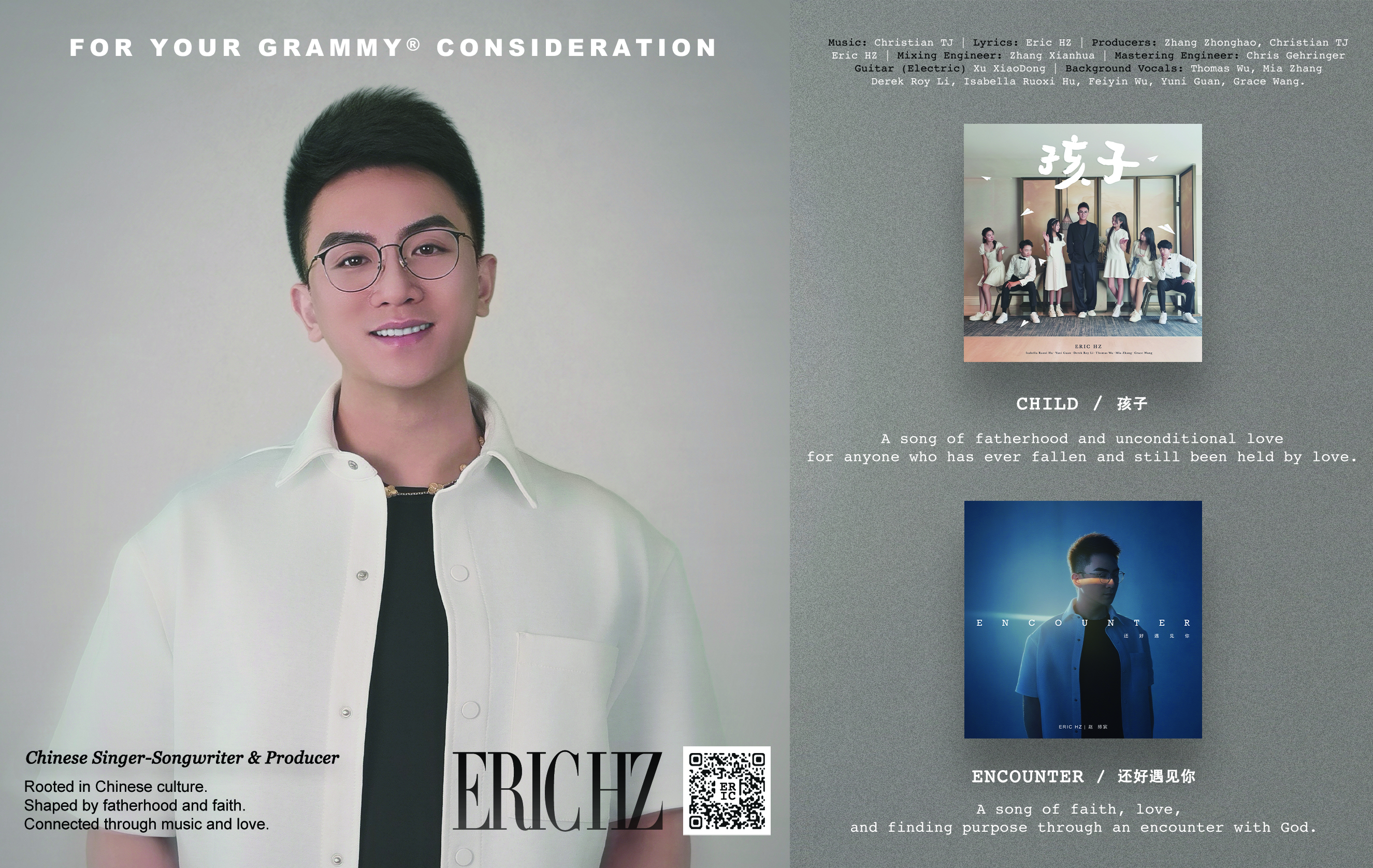
Eric HZ(Hechen Zhao)FYC
As Best Asian Pop Music Performance debuts, Eric HZ discusses Mandarin vocal expression, musical judgment, and the importance of informed listening.
The Art and Science of Listening — Part I
As the Recording Academy introduces Best Asian Pop Music Performance, Chinese singer-songwriter, vocalist, and music producer Eric HZ is sharing his perspectives on vocal science, language, and the evaluation of musical performances across cultural traditions.
Based in the Dallas, Texas area, Eric HZ studied under Chinese opera performer and vocal educator Professor Wan Shanhong. His original Mandarin-language song “Child” has been submitted for consideration in the new category.
The introduction of the award provides a timely context for an important question in vocal artistry: How can listeners maintain rigorous artistic standards while developing a deeper understanding of music expressed in unfamiliar languages?
Listening Beyond Language Barriers
Eric HZ’s reflections begin with the distinction between musical qualities listeners can directly perceive and aspects of a performance that may require additional linguistic or cultural understanding.
Even without understanding the lyrics, listeners can examine pitch accuracy, rhythm, vocal timbre, breath and phonatory coordination, phrasing, dynamic control, and the shaping and release of musical tension.
Yet singing involves more than the accurate production of pitches and rhythms. Word meanings, linguistic stress, expressive nuances, and cultural context may all influence a vocalist’s artistic choices.
A language barrier, therefore, does not make meaningful artistic evaluation impossible. It may, however, limit how fully a listener understands the expressive intentions of a work.
“Mature artistic judgment requires not only an awareness of what we hear, but also a recognition of what we may not yet understand,” Eric HZ said in his written reflections.
Rather than proposing a universal scoring formula, his approach combines careful musical analysis with a willingness to deepen understanding through lyrics, language, and cultural context—and to reconsider initial impressions when appropriate.
Vocal Science and the Musical Character of Language
Human singing relies on shared physiological mechanisms and acoustic principles, including respiration, airflow regulation, vocal fold vibration, and adjustments of the vocal tract.
Different languages, however, introduce distinctive phonetic structures and prosodic patterns that can influence articulation, timbre, phrasing, and the coordination of language with vocal production.
Mandarin Chinese provides a particularly relevant example. In ordinary speech, lexical tones contribute to distinguishing word meanings. In singing, pitch is also organized by musical melody.
Consequently, Mandarin songwriting and performance involve navigating relationships among lexical tones, melodic contour, rhythmic organization, and linguistic meaning.
This does not require every sung note to reproduce a character’s natural spoken tone. Musical context, articulation, rhythm, and semantic relationships can also support intelligibility.
Balancing linguistic clarity, melodic expression, and vocal technique therefore requires artistic judgment rather than mechanical adherence to a single rule.
“A mature vocalist should understand not only how to sing a note, but also why that note belongs at a particular moment, how it relates to the language, and what expressive function it serves within the phrase,” Eric HZ explained.
Artistic Rigor and Cultural Understanding
Eric HZ’s reflections also distinguish the common physiological foundations of singing from the aesthetic choices that emerge within different musical traditions.
Recognizing cultural differences does not require abandoning professional standards. Technical command, stylistic appropriateness, musical coherence, and expressive intention remain essential considerations.
Equally, an unfamiliar vocal quality should not be dismissed merely because it differs from a listener’s established preferences.
His perspective calls for informed evaluation rather than cultural assumptions or automatic acceptance of every artistic choice.
“The voice is the instrument of singing, language provides the material of expression, and the artist’s responsibility is to bring them together in service of the music,” Eric HZ said.
The discussion reflects a broader opportunity created by the new GRAMMY category: to engage more deeply with the varied artistic languages of Asian popular music while maintaining rigorous standards of musical evaluation.
About Eric HZ
Eric HZ is a Chinese singer-songwriter, vocalist, and music producer based in the Dallas, Texas area. He studied under Professor Wan Shanhong and is the founder and chairman of the Chinese-American Federation of Arts and Culture (CAFAC), as well as the founder and executive producer of the Chinese American Music Festival (CAMF).
His original Mandarin-language song “Child” has been submitted for consideration in Best Asian Pop Music Performance.
Music and artist information:
https://www.cafacofficial.org/eric-hz-child
Chris Jin
Chinese-American Federation of Arts and Culture
festival@cafacofficial.org
Visit us on social media:
YouTube
Eric HZ Performs “Child” at the 21st Chinese American Film Festival Golden Angel Awards
Legal Disclaimer:
EIN Presswire provides this news content "as is" without warranty of any kind. We do not accept any responsibility or liability for the accuracy, content, images, videos, licenses, completeness, legality, or reliability of the information contained in this article. If you have any complaints or copyright issues related to this article, kindly contact the author above.
